

An essential guide to the AI search era for people who make and sell beautiful things
Last weekend, I used Google Search a ton. For different things, different searches, and every single time, it came up with AI Mode.
Not once did it give me an AI Overview. Not once did it serve up the old familiar page of blue links and rankings. We went straight into an AI-powered conversation.
Even being pretty tuned into what’s been happening to search, I was shocked.
If you’ve been feeling the ground move under your feet these past few weeks, I’m with you. Something enormous has changed, and it’s changed fast. Many of us in business, and plenty of people just going about their lives, are feeling it. Confused? A bit panicked? Wondering what the heck is going on with search?
I know I’m not the only one asking, and I know many in interiors feel lost as to how their clients and customers are searching now. There’s some generic research floating around about search habits, but there’s nothing substantial (yet) on how the interiors and architecture trade, or the home shopper, is actually finding their way to what they want to buy. There’s no ‘one way’ to search anymore, and we’re largely in the dark about which way our people are choosing.
So this is my attempt to answer that question. Not from the standpoint of a techie SEO specialist (as I’m not one). I’m a brand strategist with a couple of decades of experience in interiors and design, who has thrown herself fairly deeply into the digital marketing, AI and search arena over the last few years. My job, as I see it, is to bridge the gap between brand strategy and SEO for our niche. To translate, in plain English, what on earth is happening for people who don’t love the language of dashboards, ranking reports and reams of statistics.
Whatever your feelings on AI, whether you’re leaning in fully, cautious, or resisting it entirely, the search engine that’s been our default for so long is moving towards AI as the everyday experience. You can still filter back to classic results if you go looking for it, but for most searches and most people, AI is becoming what you get without asking.
My promise upfront: this is a tech-bro free zone. No hyperbole. Just a clear description, specifically for those in the business of interiors, of what’s changing, why it matters for our sector, and some small, manageable steps to keep your business distinctive and discoverable even as the ground takes us in an unknown direction.
Bookmark this. Make a cup of tea and read on.
Out with the old, in with the new
Keyword optimisation, bidding, PPC campaigns… we finally got a handle on the things that helped our brands come out top in the digital search world, and then 2023 happened.
Suddenly, millions of people were using ChatGPT and other AI tools for more than just novelty poems. We found that, miraculously, we could get tailored answers and recommendations in one place. No more twenty-seven open tabs and trawling lists of blue links. And as the models improved, the results got better too.
For most of the last decade, ‘search’ meant a predictable split between paid and organic: start with a few keywords and earn a stream of research-led clicks. Open Analytics, see where the click happened, where it went, whether it converted. Neat.
Then AI arrived, and search became a conversation. Tailored to the person asking, and taking place in dedicated, ad-free (for now) environments rather than across the open web. The path to discovery has moved on from Google → website → purchase. Now it’s a truly multi-platform journey, weaving between AI tools, social platforms, forums, video and traditional search in myriad combinations.
If you’re an interiors or lifestyle brand, especially an independent without big agency budgets, this is less a tremor and more a Richter-scale quake. Your search strategy suddenly feels out of date, and you’ve got more questions than answers. You’re unsure where to place your budget, and the overwhelm is very real.
First: you’re not alone. We’re all working through an unprecedented change.
Second: this is still early. Now is the time to take stock, understand what’s shifting, and adjust (not reinvent) your strategy while the ground is still moving.
This piece will help you do exactly that.
From monopoly to confidence journey
It isn’t often these days that we watch something which was once a monopoly splitting apart.
But that’s what’s happening with search. Now, for the first time, people have choice and agency to look beyond Google. ChatGPT, Perplexity, Pinterest, TikTok, YouTube, Reddit… each one a front door of its own, fulfilling a different need. Pinterest is moving from pure inspiration to active comparison. For Gen Z, YouTube has already overtaken Google as the top search platform. The challenge for brands is to know your audience, work out which combinations they’re using, and meet them there.
Now, search has had something like an existential crisis. It’s shifted from pure discovery towards confident, customised choice, with verification and validation layered in.
For customers, it can feel like taking back control. For brands, the journey is no longer neatly trackable or predictable, and it can feel like you’ve lost the map.
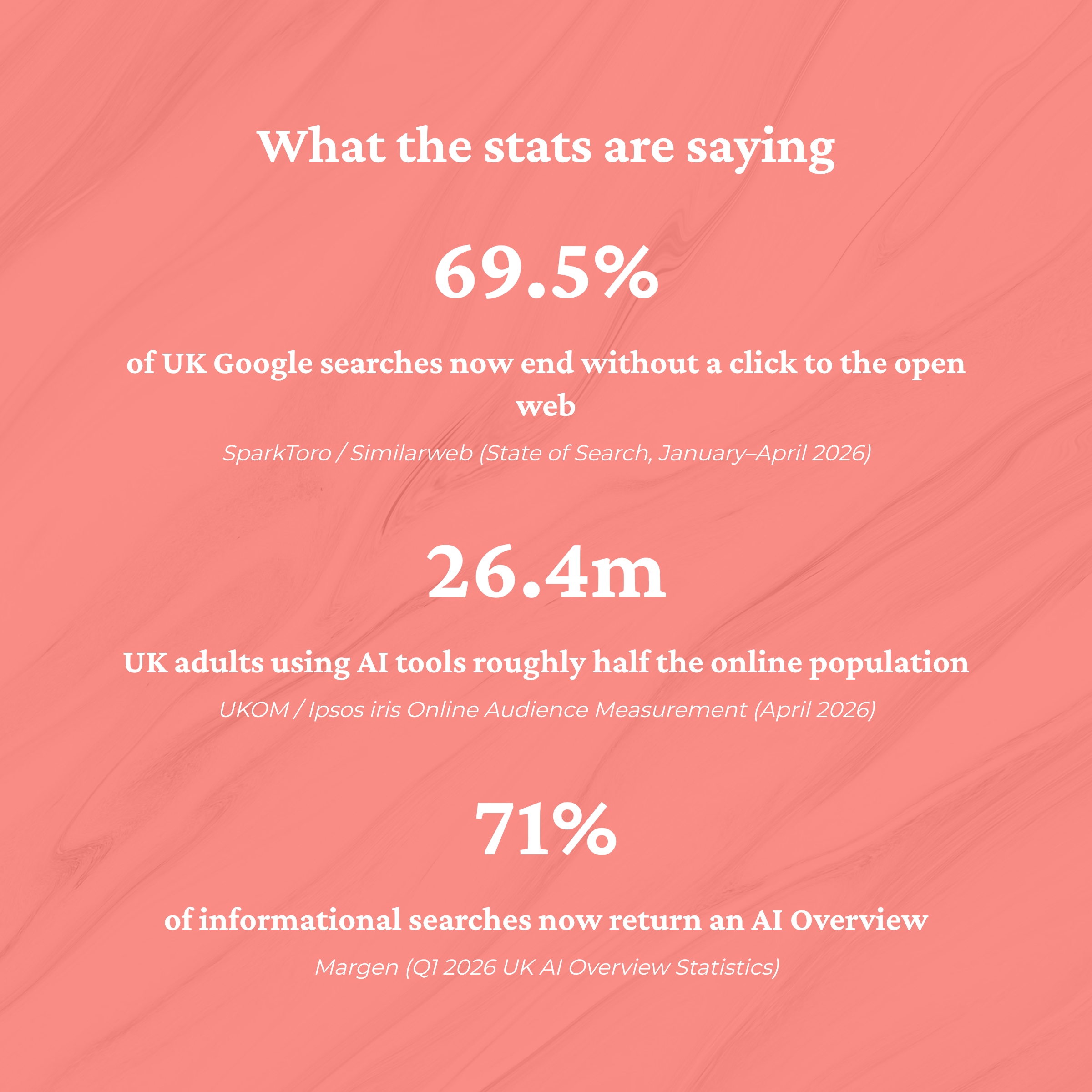
In the UK, this is happening at mainstream scale. As of April 2026, roughly half the adult online population were using AI tools. At the same time, we’ve reached a historic high in zero-click searches - over two-thirds of Google searches end without a click to the open web. AI Overviews now appear across a large share of those searches - as many as 47% of UK desktop queries and 53% on mobile, rising to 71% for informational ones. When an Overview shows up, click-through rates do a bit of a nosedive.
On the surface, it looks like people are getting answers and recommendations without ever leaving their preferred tool. But that’s not quite the whole picture.
One-and-done is not how the modern buyer searches.
There’s growing evidence that people are building what you might call ‘discovery stacks’ – meaning they’re moving between search engines, AI tools, social platforms and forums before they decide. The fastest-growing segment is the multi-platform searcher (15% of the market and growing), combining social search with AI, shifting between platforms as they go.
And there’s another layer: it isn’t only people doing the cross-checking. The AI tools are doing it too: pulling from the web, reviews, forums, video and brand sites to sense-check and support the answers they give us.
This is the key point. AI is increasingly the introduction, not the final act.
AI summaries can create awareness, but high-consideration decisions still need verification. Nearly half of people using AI to research say they turn to traditional search and review sites to validate what they’ve seen. Younger users in particular click links inside AI Overviews to check claims.
For interiors and lifestyle businesses, none of this will come as a surprise. Taste is personal, and trust is paramount. The perceived risk of purchase is high in our sector - financially, emotionally, and reputationally (especially for trade buyers). People want reassurance and proof of quality, craft and provenance. There are sectors where an AI recommendation might close the deal.
Ours isn’t one of them.
We need to talk about Google
I find it helpful to try to stop thinking of Google as one thing. Because in the here and now, it’s three distinct experiences: Traditional Search, AI Overviews and AI Mode:
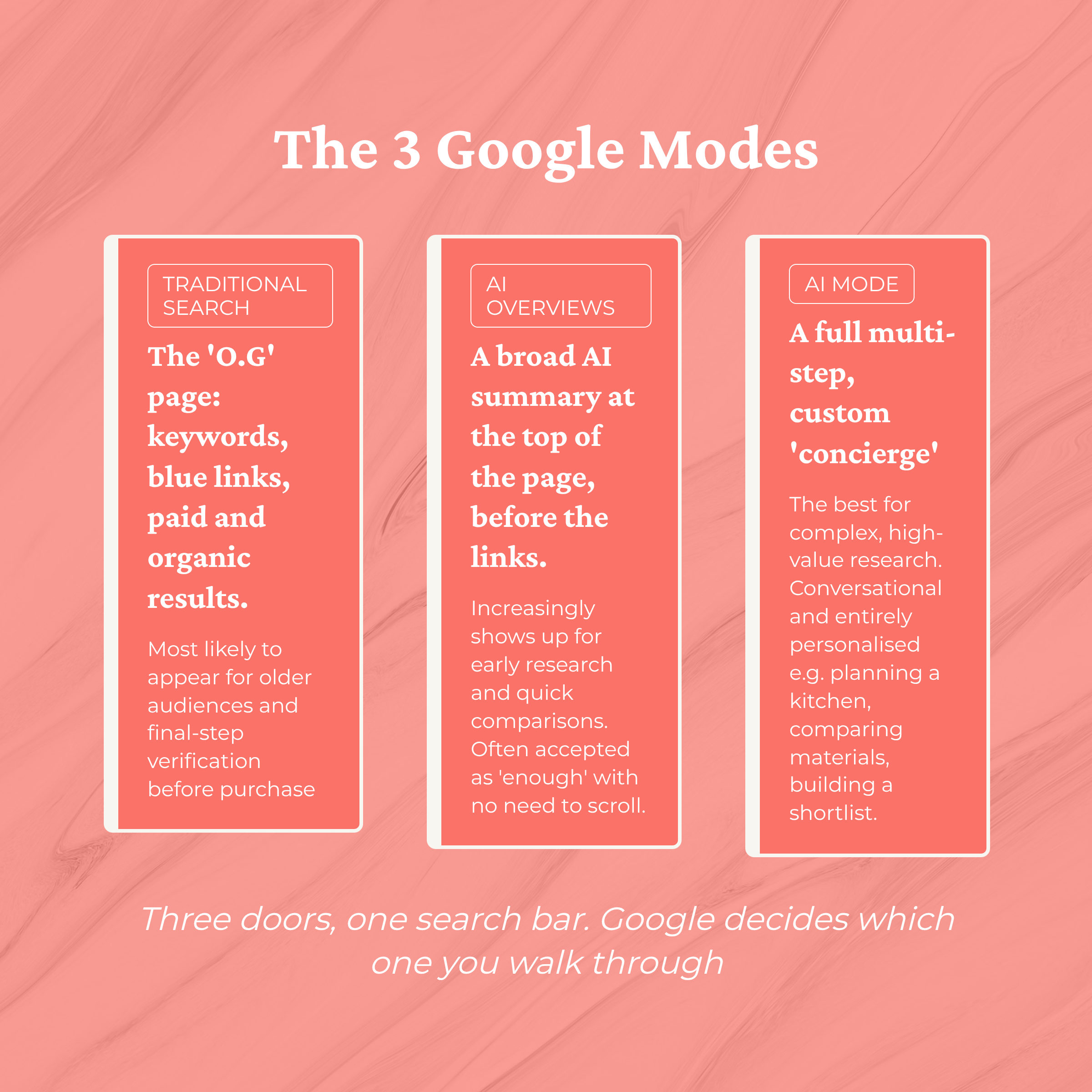
Traditional search still has its place (when it is offered up, of course), particularly for older audiences and for final-step verification before purchase. AI Overviews show up more often for early research and quick comparisons and are increasingly accepted as ‘enough’. AI Mode is best employed for complex, multi-step projects - the kind of research that looks like planning a kitchen, comparing materials, or building a shortlist for a high-value purchase.
The most useful advice I can give is: don’t try to be everything to everyone, everywhere. You are better off investing your time establishing which part of Google your audience is most likely using, and what role it plays in their confidence journey and taking intentional steps to meet them there, with what they need. But this comes with a caveat…
As I discovered last weekend, Google is like a box of chocolates; you don’t know which of its three modes you’re going to get. It decides whether you land in blue-link territory, get shown a summary, or are invited into a deeper conversation - depending on the nature of what you asked. There's a 'Web' filter if you want to see classic links, and Google's official line is that AI Mode isn't the forced default, but when was the last time you chose the 'Web' tab?
Although Google holds the reins in this regard, what we can do is make sure our content is ready to serve whichever mode Google is most likely to select, and that comes down to what your people are actually asking for.
Risky business: why interiors queries go deep
Let’s drill into search specifically for our lovely niche, because it isn’t one-size-fits-all.
Let’s say you’re searching for a low-value commodity item, short-term, easily replaced. You’re happy for search to give you a quick summary. You’re more likely to stick with Google, and it’s more likely to present you with an Overview. Here’s what you need, here are the top three suppliers, go. Easy.
Interiors is different.

Nkuku’s lifestyle store in South Devon - why would you not want to step inside?
From an interior designer sourcing for a residential or commercial project, to a homeowner upgrading their dining table for a growing family – we’re talking substantial investments in our world, in the main. You want quality and reassurance that the product will fit your exact needs. You’d like it to be delivered smoothly and on time, and last you for a long time to come.
Searching for this kind of product needs slower, more analytical thinking. You’re more likely to do deeper research, look closely at real reviews, shop around and compare options.
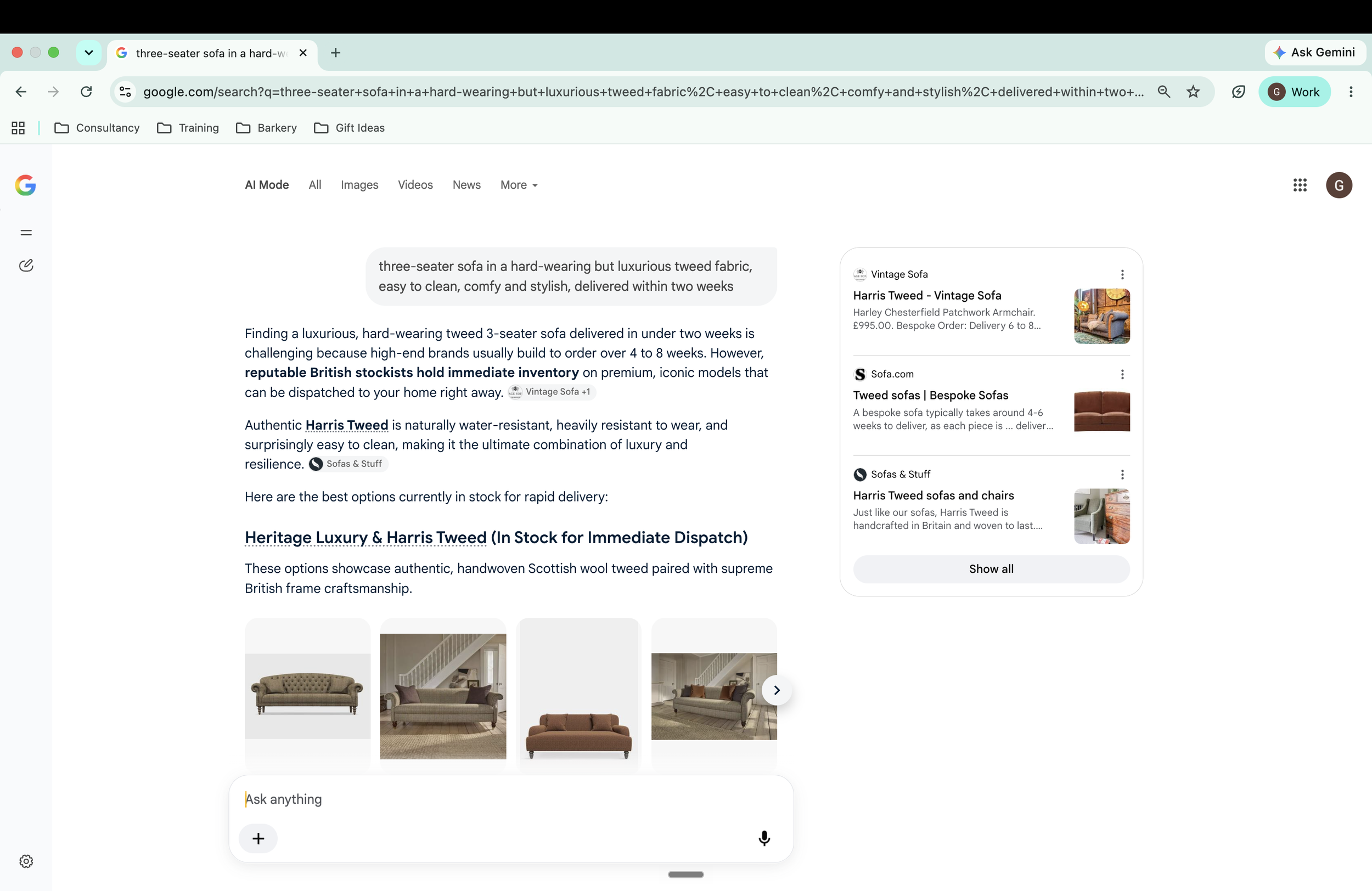
And the searches themselves are getting more conversational. People don’t type ‘sofa’ anymore. They ask for a “three-seater sofa in a hard-wearing but luxurious tweed fabric, easy to clean, comfy and stylish, delivered within two weeks”. I call these ‘concierge queries’ - hyper-personal, context-rich prompts where an AI behaves like a personal shopper. That’s exactly how interiors buyers think, and it swings hugely in favour of brands who can prove, through clear, structured content, that their product ticks every one of their boxes.
What that means in reality is:
· Interiors shoppers spend more time exploring multiple sources.
· They’re more likely to bring AI in as a ‘personal shopping assistant’ for detailed, customised research.
· But they are far less likely to trust AI’s recommendations fully and even less likely to let it complete the purchase.
· They will almost always follow up by verifying in other ways, be that on the brand’s own website, social media, forums or a visit in-store.
Because:
· Trade buyers need to drill into the details, requiring human verification at the highest level.
· Luxury buyers need a white-glove service that a chatbot can’t provide.
· Mid-to-high retail buyers need confidence that something will work in their space, with their life.
This is why AI Overviews are rarely the main event for a meaningful interiors purchase, and why AI chatbots are an increasingly important part of the journey, but with trust still low, independent verification closes the sale, every time.
Be the answer: specificity + trust + proof
The threads running through all of this are specificity, trust and proof.
Generic won’t cut it anymore. The web is filling up with flat, samey, synthetic content that humans are bored by, and AI crawlers skim past, looking for something more specific.
In this world, the brands that can prove their difference and their trustworthiness have the advantage and there’s mounting evidence it’s working: AI citations are no longer tightly tied to the top ten organic results. Recent data shows a drop from 76% to 38% in citations coming from top-ten-ranked pages. So being ‘the biggest’ is no longer the only route to being found. A huge win for the Davids over the Goliaths. Being clear, useful and easy to cite can see you coming out ahead in AI recommendations regardless of where you sit on the blue-link ladder. For independents, that’s really good news.
This is the one point I’m going to get a bit SEO on you. Bear with me, because there’s something important here that crosses the tech / real life divide.
E-E-A-T.
It stands for Experience, Expertise, Authoritativeness and Trustworthiness, and it originates from Google’s ‘Search Quality Rater Guidelines’, the document human raters use to assess search results.
It reflects what Google values and rewards in content. Think of it less as an acronym and more as a practical brief because it still stands as the backbone for good quality content:
· Show real Experience.
· Demonstrate Expertise.
· Earn Authority.
· Build Trust with visible proof.
For interiors, with aesthetics at the core, proof often needs to be visual.
That might be video - the ultimate antidote to AI - not in the shape of a glossy brand film, but human-led answers, demos, experts and evidence. Show, don’t tell is the new mantra: swatch tests in different lights, scratch tests, maker interviews, installation walkthroughs, care and aftercare, real customer homes. It doesn’t need to be perfect. In fact, it shouldn’t be perfect. It should be real. Ironically, being real has never mattered more.
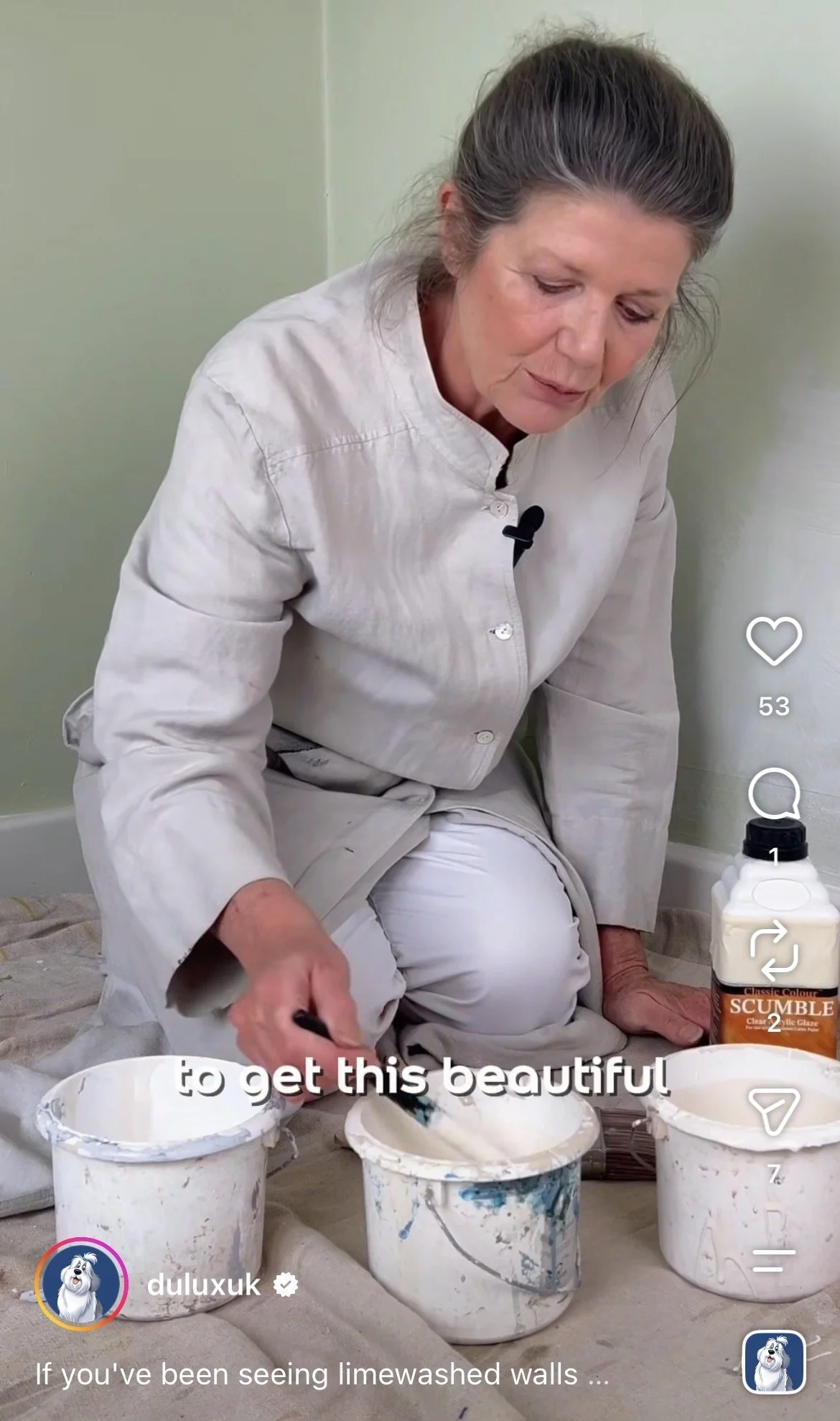
Dulux’s hands-on videos show us how to easily create paint effects on our walls
And your website’s job is different now, too. Don’t go thinking, in a zero-click world, that it no longer matters. It’s just had a career change. It’s pivoted from brochure to verification source. That means it is:
a) the place people go after you’ve been recommended somewhere else, and;
b) the source AI uses to recommend you in the first place.
It’s still really important you invest in your website content.
Getting practical: where to start
Let me give you some reassurance straight off the bat. Although the search landscape has changed, a lot of what you’re likely already doing doesn’t need to.
If you’re already:
· Writing in your own clear, distinctive voice - not a generic or inconsistent one
· Showing your work - your makers, your process, your people - not just your end products
· Keeping your website clean, current and mobile-friendly
· Gathering and using real customer reviews
· Showing up consistently on the platforms your audience actually uses
…then you’re not starting from zero. You have good foundations. The job now is to build on what you have and move in the right direction.
I’d suggest starting with a health check - the kind of thing I do in my Brand Compass. It’s a line in the sand so you can see where you actually stand before you decide where you need to go.
A few of the things I look at:
· Whether your brand foundations/voice are as defined and distinctive as they need to be to ensure you remain discoverable, plus clear and comprehensive enough to leave no room for error
· Whether your site is clean, accurate and smooth to understand and navigate, and whether it builds trust and provides proof on every page
· Whether the things that make you credible (press, awards, case studies, client words) are actually readable on the page, or stuck inside images where search and AI can’t reach them
· Whether you’re showing up in the AI queries that matter to your audience, how you’d even know and what you’d do about it if you weren’t
That’s the shape of it. A few more things worth doing:
· Audit your website experience from that first introduction to making an enquiry, browsing and checkout, especially on mobile. Buy something yourself, as a first-time customer would. Feel the experience – the good, bad and the ugly. Then work out what needs to change first to make it better.
· Review your product pages and ensure they are detail-rich (but quality and clean in format). This isn’t just for the AI crawlers (although they do love comprehensive, easy to read information). Customers now want this too – they don’t want you to gatekeep the details; they are proactively browsing, comparing, selecting, they want to know it all and will reward those who provide it openly.
· Write down the prompts you want to be cited in – what is your target audience asking their AI ‘concierge’ or typing into the ‘new’ Google? Run them for real and see if and how you (and your direct site) feature. Where you’re missing, low down the response or incorrectly cited is your priority to fix.
· Read (and respond to) ALL your reviews, especially the bad ones. They’re a map of your customers’ uncertainty. Ignore at your peril.
Don’t panic - one step at a time
Here are a few trends I see developing, and worth keeping an eye on as you adapt your business in parallel.
Verification, as the era of AI search unfolds, is going to get more and more valuable. It is a good thing that interior shoppers are savvy and a little distrustful of AI as they search for pieces for their precious spaces. Long may it continue. Let’s keep investing in being the primary source they come to for reassurance.
Video-first search behaviour will age up into the 25-34 and 35-44 demographics, and it’ll be critical for AI search too, with YouTube now a citation source exceeding Reddit. If you’re futureproofing, start thinking about how video best sits within your business. (John Lewis’s YouTube gift-list content for Christmas 2026 is a key reference point for our sector.)
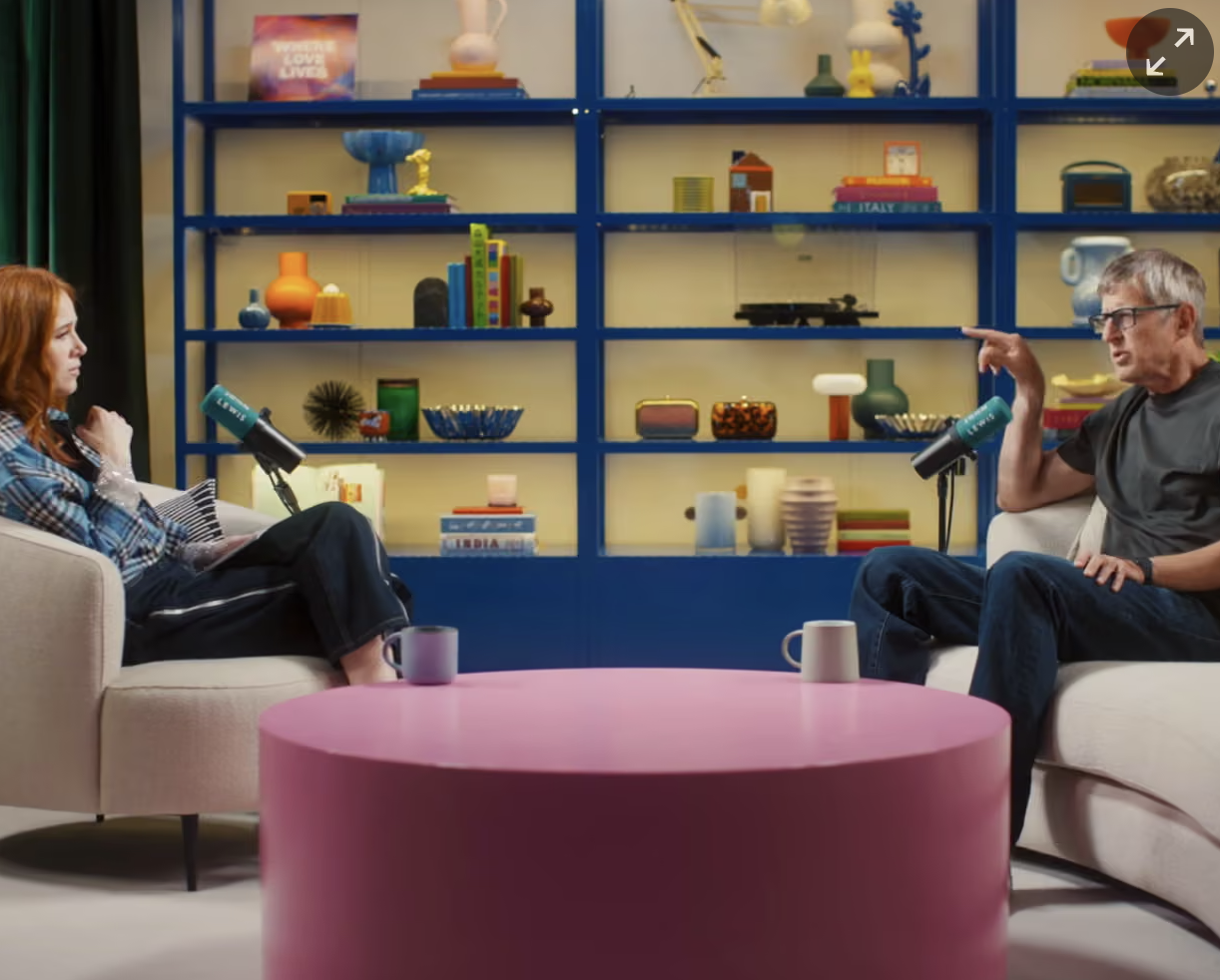
John Lewis launches a Gift List vodcast this Christmas
‘Agentic commerce’ will grow - that’s the term for AI agents carrying out tasks on your behalf, including browsing, comparing and even completing purchases with minimal human input. Shudder. But consumer comfort with automated checkouts is still mixed: 46% of UK consumers say they’re uncomfortable with it, and I’d bet money that figure is dramatically higher for interiors shoppers. So keep investing in your very human customer service teams and systems. Personal, warm, friendly service will be king for a long time to come in our sector - hurray!
Visual search will keep rising, especially for product discovery. If you’re considering AI-generated or enhanced imagery, be selective. It’s good, but it’s not that good and many discerning interiors buyers will sense something is off, and then trust is at stake.
The long-term objective for interiors and lifestyle brands is simple: build proof-rich, human-led content that people will trust, and that machines will increasingly cite.
Keep calm and play the long game
There’s a lot to take in here, I know.
But I, for one, am glad the era of gaming the traditional search system to top the rankings is over. I’m glad trust and proof are getting their moment.
My advice is don’t tear up your strategy, evolve it. Go back to basics a little. Do some foundational work, because it will serve you well to start from a solid brand foundation that can inform everything that follows.
Work out why and how you’re distinctive. Who your people are, where they are and what gives them confidence to choose. Then tell your story clearly, to those people, in those places. Be specific and provable. Strive to be beloved by your people, not by everyone.
Because in this new world, being discovered is only the start.
Being chosen is ultimately what will make your business thrive, and trust is what will get you there.
A note on sources: figures referenced are drawn from UK AI adoption and search behaviour data, 2026.
