
The 10 Principles of Good AI Adoption (for design-led, independent brands)
If you’re a founder or leader of an independent interiors or lifestyle brand, AI probably feels like two things at once: a genuine opportunity to lighten the load, and a genuine risk to the business you’ve spent years building.
That’s understandable, because the stakes are different for independents.
Big businesses can afford a bit of experimental chaos. They can waste budget without too much worry and recover from a few messy missteps. Independent, design-led brands are built on trust, taste, care and consistency - all hard-won elements that, once diluted, are very difficult to rebuild.
So rather than rushing headlong into the latest tools, features and trends, I prefer a principles-led approach. One that helps you bring AI in positively, with long-term success in mind - not short-term box ticking.
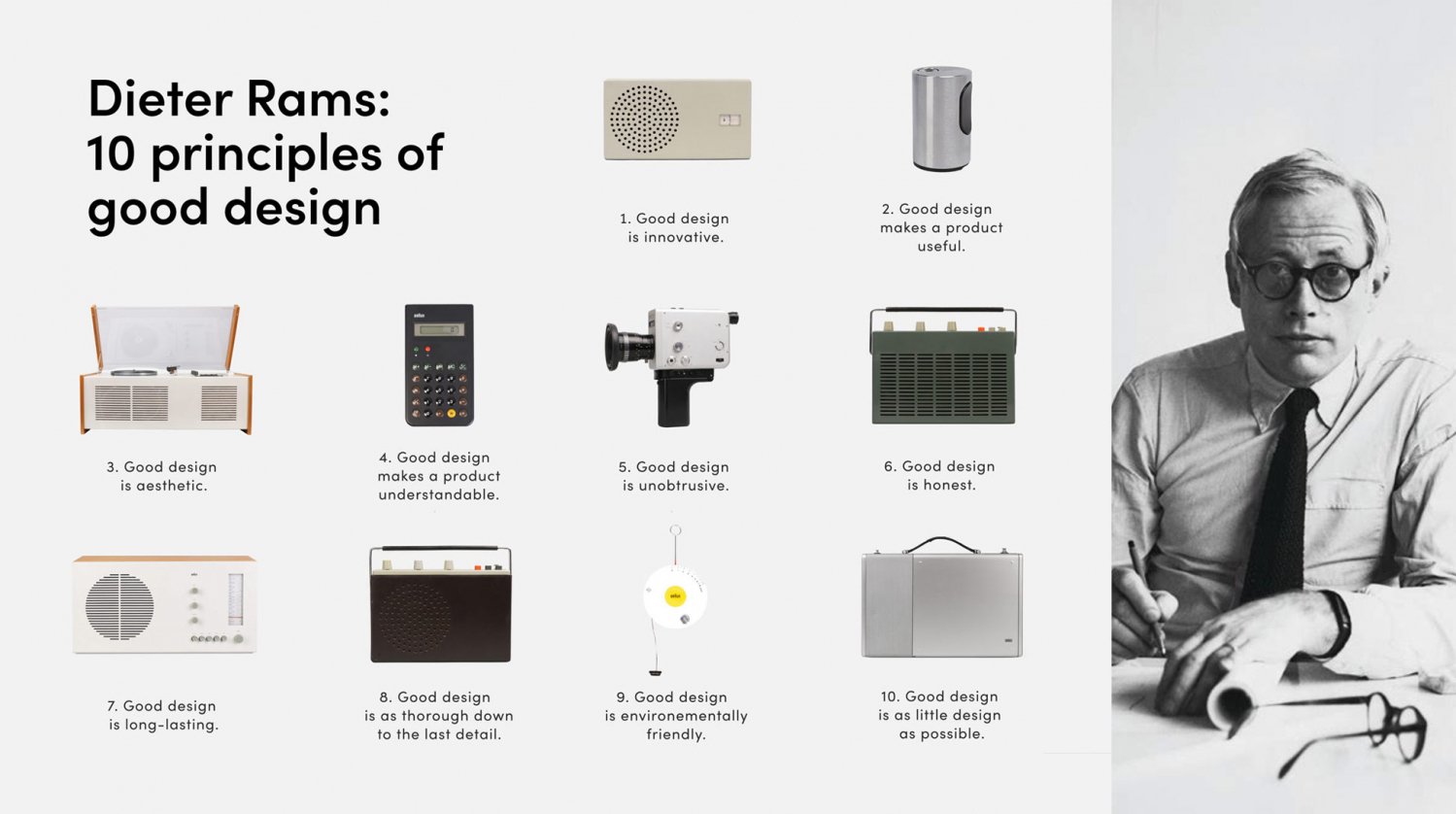
Having lived and breathed interiors and design throughout my career, I’ve always been inspired by Dieter Rams’ 10 Principles of Good Design - a set of foundational ideas that have outlived decades of changing fashions because they go deeper than style.
Fifty years on, I believe we need the same compass points to steer our course in the AI era.
Principles over profit. Principles over speed. Principles over efficiency.
Not because efficiency is a bad thing (far from it), but because chasing efficiency while leaving standards and care behind is how brands lose what makes them truly distinctive.
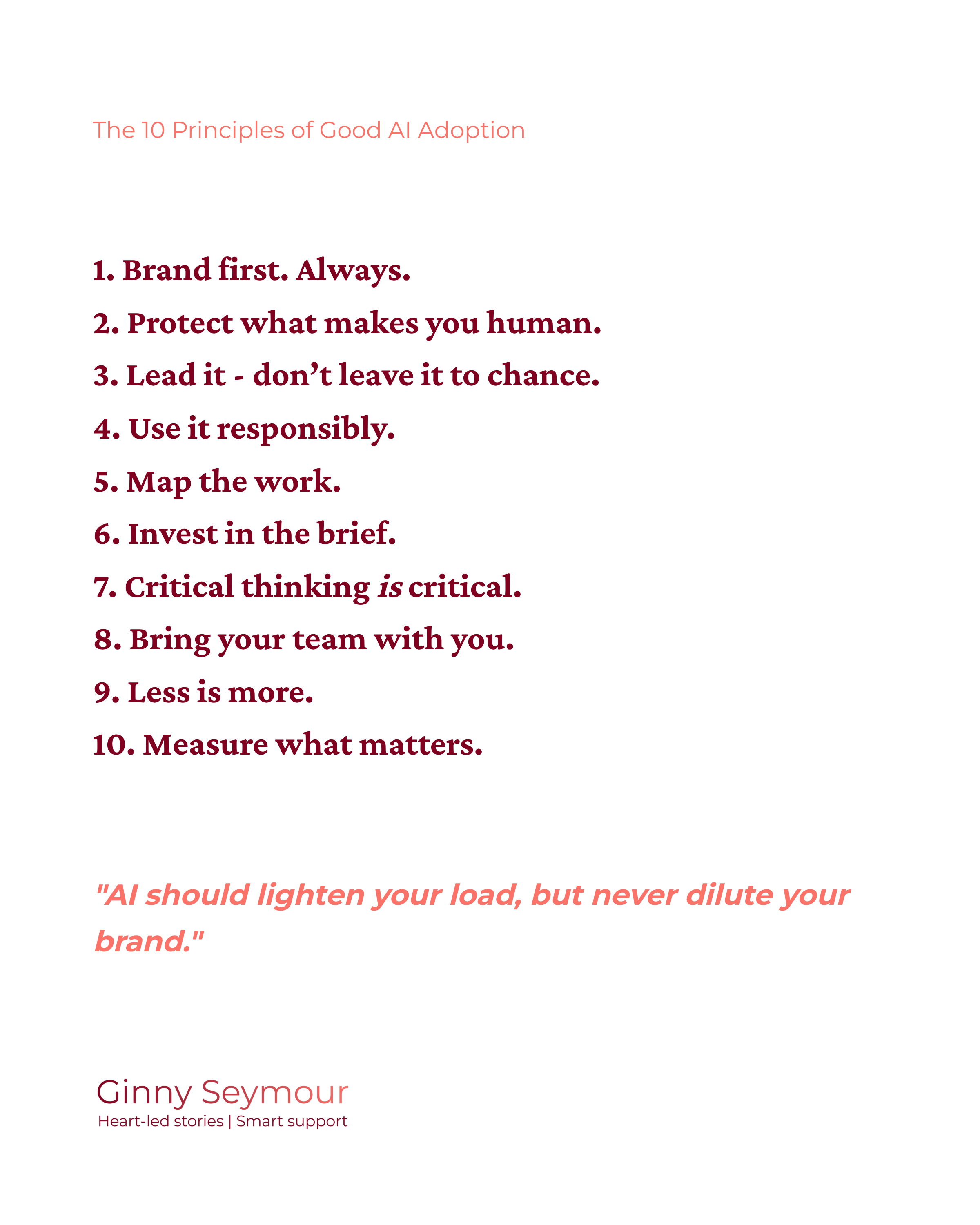
So here are my 10 Principles of Good AI Adoption, crafted for independent, consumer-facing brands (especially interiors, lifestyle and retail) who want to explore how AI might help them -without the rush, without the overwhelm, and without sanding down anything that makes them worth choosing.
A quick note on what I mean by AI adoption
When I say adoption, I don’t mean buy a tool, dish out some licences and hope for the best.
mean leadership-led change that becomes a shared way of working. I mean bringing AI into your business on your own terms - with intent, control and confidence.
All ten principles work towards a collective goal: lightening the load, but never diluting your brand.
Let’s get into it.
Principle 1: Brand first. Always.
My number one for a reason, and the hill I will die on.
You go nowhere near AI if you haven’t defined your brand first.
AI is not a shortcut nor a replacement for strategy. It will multiply and amplify what you give it. If your brand is clear, it can help you move faster and more consistently. If your brand is undefined or open to interpretation, get ready for the chaos.
What ‘brand first’ looks like in practice
Your positioning, values, customer profile and voice are written down (not just in someone’s head)
You and your team can describe the brand in plain English - who you are, what you do, who you’re for, what you stand for
People across the business can make joined-up judgement calls (so the brand feels consistent wherever it shows up)
Example: If your brand is built on quiet confidence and considered taste, AI shouldn’t be producing shouty, salesy copy just because that’s what a competitor is doing. Your tone is part of the fabric of who you are.
Try It
Create a one-page brand “non-negotiables” sheet:
Voice (3 adjectives + what to avoid)
Customer (who we’re for, who we’re not)
Standards (what ‘good’ looks like)
Boundaries (what we never do)
Then choose a tool that can store and remember context and train it properly, like you would a new member of your team. Think of it as a brand induction that influences everything it ever gives you.
Principle 2: Protect what makes you human.

AI can research, summarise, organise and speed up. But it’s not great at the parts of brand-building that make customers feel something.
For independent brands, the human bits are often what sets you apart:
Taste and judgement
Warmth and care
Nuance
Originality and creative flair
Spontaneity
The small moments that make people come back (and tell their friends)
A simple way to think about it:
Use AI behind-the-scenes to smooth processes and free up headspace
Be more careful front-of-house where your brand is experienced
Customer loyalty isn’t gained through efficiency. Loyalty is fostered and retained by brands who are thoughtful, personal and worth trusting.
Try It
Ask this before handing a task to AI:
If we moved this from human to machine, would the experience feel more seamless or more forgettable?
Principle 3: Lead it - don’t leave it to chance.
AI adoption is a leadership decision and a behaviour-change project. It’s not an IT initiative.
When leaders don’t take charge, a few predictable things happen:
Everyone experiments in different ways with different tools
Standards get diluted (and your brand voice starts to wobble)
Customer data and sensitive info gets handled inconsistently
Team members decide it’s more hassle than help
You don’t have to be the most technical person in the room to lead AI adoption but you do need to set the direction.
Try It
Three leadership questions that steady the ship from the start:
What will we use AI for (and what will we not use it for)?
What standards are we setting (tone, quality, privacy, accuracy)?
Who is responsible for guidance and sense-checking?
Principle 4: Use it responsibly.
This is the pause button.

AI tools are powerful, and there are different ways this can go depending on the path you choose. For independent brands, trust is central to everything. It’s built slowly through consistency, care and integrity.
Responsible use means:
Choosing platforms/models/membership levels with care (not just ‘best for the job’, but right for your values and risk profile)
Treating customer/client data as sacred (be clear what can go in, how data is used/stored, and what must stay confidential)
Respecting IP (yours and other people’s)
Being clear with your team about what tasks can be AI-supported and what stays human-led
Verifying outputs, especially when facts, people or reputations are involved
Saying no when it doesn’t align with your values
Try It
Create a simple traffic-light list:
Green: safe, low-risk tasks (e.g., summarising your own notes)
Amber: needs review/guardrails (e.g., drafting customer emails)
Red: never goes into AI (e.g., sensitive customer data, confidential contracts)
Principle 5: Map the work.
Before you bring AI into anything, get clear on how the work actually happens now.
Where do you repeat yourself? Where are the delays? Where is quality lacking? If you can’t see it, you can’t improve it.
Otherwise AI doesn’t fix or improve anything - it just compounds the mess.
Example: If your product descriptions are inconsistent, instead of dumping them all into an AI tool to rewrite them, first work on:
An agreed structure
A shared vocabulary for descriptors, terms and names
A definition of what customers actually need to know (and what will persuade them to buy)
Map first. Then decide where AI can support.
Try It
Capture the process for one recurring task:
Inputs (what you start with)
Steps (what actually happens and who is involved)
Decision points (where judgement is needed)
Outputs (what ‘good’ looks like)
Barriers (where it slows down)
Then use AI as a thinking partner to spot improvements that could be made, with or without its help.

Principle 6: Invest in the brief.
AI isn’t a mind reader. It’s only as good as what you give it.
A good brief (in AI lingo, a ‘prompt’) turns AI from gimmick into genuinely useful support.
What a strong AI prompt includes:
Context (what this is for, why it’s needed)
Audience (who it’s for, what they care about)
Constraints (what to avoid, what must be included)
Examples (links or snippets to support a good result)
Tone (how it should feel)
Definition of “done” (what “good” looks like to you)
Try It
Create a master list of non-negotiable elements that every AI prompt should include (like the above) for all team members, for every task.
Let your team get hands-on in their learning of how to brief AI tools, assess the output and learn what worked and what didn’t. Practice beats theory all day long.
And remember: choose tools that can retain business and brand context so the work stays consistent, whoever is guiding it.
Principle 7: Critical thinking is critical.
Prompting and context at the outset matters, but human judgement throughout the process matters more.
AI outputs can look ‘good enough’ while being subtly off:
Slightly wrong facts
Wrong tone
Overconfident claims
Generic phrasing that anyone could have written
This is a big one. Trust your AI tool as much as you would a new team member: capable, with lots of potential but not ready to go unchecked.
Your responsibility is to sense-check, edit, verify, and keep standards at the forefront.
Try It
Create a quick quality checklist for every AI output:
Is it true?
Is it us?
Is it useful to the customer?
Is it specific enough to be credible?
Would we be proud to put our name to it?
Principle 8: Bring your team with you.

AI shouldn’t be a free-for-all, but it shouldn’t be a mystery either.
If you want AI to stick in a way that lasts, you need shared language, shared standards and shared confidence.
What this looks like:
A simple AI use policy (try and keep it to one page)
Training that’s hands-on, collaborative and ongoing
Space for questions and nerves (because people will have them)
Consider appointing AI Champions to help lead the change
Try It
Make AI an open cultural change project. Set up a monthly show-and-tell where the team shares one way they used AI (or would like to) that saved time and met brand standards.
Principle 9: Less is more.

Ignore the noise - you don’t need all the ‘must have’ tools and fifty thousand ways of using them. That’s the fast track to overwhelm.
Start small: a select number of easy-to-trial, high-impact tasks. Do them thoroughly, learn what success looks like for your brand, and build from there.
What usually happens otherwise? ‘Tool sprawl’ (think ‘too-many-cooks, AI style’) which creates:
Inconsistency
Confusion
Risk (more logins, more data moving around)
Increased cognitive load and stress (which is not the point)
Try It
Pick 3 use cases to start. A sensible set for many brands:
Internal summarising + decision support (meetings, notes, next steps)
Content repurposing (summarising and reshaping what you’ve already created)
Insight and research (audience, competitors, spotting what you may have missed)
And one bonus use case I love for founders: ask AI to be a thought partner and questioner - to challenge your thinking and push you out of your comfort zone.
Principle 10: Measure what matters.
There’s a lot of polarised opinion out there on the ROI of AI. In reality, it comes down to what success looks like for your business and making sure you bring AI in to support that.
Yes, time saved can be a real benefit. But for independents, some of the biggest wins are often about momentum and decision-making: using AI to move projects forward where there wasn’t budget for extra human resource in the first place.
So look for impact you can actually feel making the business better:
Fewer delays and bottlenecks
Increased consistency (especially in brand voice and customer comms)
Faster decisions and clearer priorities
Calmer teams (less frantic last-minute work)
Improved customer experience (more helpful, more personal, more consistent)
More creative headspace
Try It
Choose 3 metrics for the next 30 days:
A Time metric (e.g., time to repurpose content)
A Quality metric (e.g., fewer rewrites, fewer customer clarifications)
A Commercial metric (e.g., increased return customers, improved conversion)
The thread that runs through all ten
If you take nothing else from this post, take this:
AI adoption isn’t about doing more. It’s about protecting what matters while you make the day-to-day lighter.
Start with your standards (so the brand stays the hero). Keep the human moments human (they’re irreplaceable). Lead from the top so it doesn’t turn into a free-for-all. Do a bit of prep before you hand anything over - map the work, be clear on what you want and always apply your judgement before anything goes out into the world. Keep it simple and pay attention to whether it’s genuinely making the business better, not just faster.
Where do I start?

Principles in theory are one thing, taking the first step is another.
The principles are the map, but navigating change may still need a guide.
If you’ve read this and it resonates, but you’re unsure how to apply it in your brand and your team, that’s exactly what The Signal Read is for.
It’s my entry point for founders and leaders who want an insightful, motivating, brand-safe starting point. We take the principles and turn them into a practical plan you can actually follow.
You’ll leave with:
Your brand standards and non-negotiables defined (so AI has a clear job description)
A simple, safe starting point for AI use (what to do first, what to avoid)
2-3 tailored use cases that fit your team and your customer experience
A 30-day action plan with priorities (not a long wish list)
If you want to start well, and keep your brand intact while you do, let’s chat.
A final thought
Dieter Rams’ 10 Principles of Good Design have remained relevant for over 50 years because they’re timeless.
I believe the same can be true here.
The tools, capabilities and opportunities will keep evolving (sometimes daily). But we can choose to bring them into our businesses with intent, thought and meaning - taking time to pause, prepare and plan in a way that reflects and protects who we are, and who we want to continue to be.
