
AI can’t improve what you don’t understand
Independent business leaders (and their teams) often run the day on muscle memory.
They’re brilliant at what they do. They live and breathe the brand. The systems live in their heads. They move through tasks with an unconscious rhythm that just works.
Which is exactly why bringing AI into the picture can feel so uncomfortable.
When the ‘how’ isn’t written down in black and white, it’s impossible to know what you’re trying to improve, let alone brief a tool properly.

Muscle memory is a strength… until it’s time to evolve it.
Most founders know their why and their what. But very little of the how - the exact steps, timings, handovers and decision points - is captured in black and white.
That becomes an issue the moment you start looking at where AI could help - because AI can’t support a process you haven’t defined.
To move towards that clarity, you need to capture the full reality of how work happens today. Not the idealised version. Not the version you wish was true. The real one (warts and all), including the workarounds, the back-and-forth, the “I’ll just do it myself” moments.
Until you understand your processes, you can’t make a confident call on:
where AI could/should step in
where it definitely shouldn’t
what needs fixing before you add anything new
The trap: shiny new tools on top of undefined processes

If your processes are undefined, bringing in AI is usually adding shiny new tools to the mix, hoping for magic but actually just adding to the chaos.
Sometimes it looks productive at first - lots of output, lots of activity.
But underneath, the same problems remain:
delays
confusion
duplicated effort
inconsistent decisions
quality that varies depending on who’s doing the task
AI hasn’t done anything to solve those issues - you’ve just put a rocket under them all.
Start here: document how work actually happens
This is the unglamorous part, I’m afraid. But it’s the foundation on which any business making steps, however small, into the AI era should be built.

Start documenting - even (or especially) if it’s messy.
There may be five different ways your team gets to the same result. Capture them all.
There may be a process you absolutely know is not the best way it could be done. That’s the point. Note it down.
Add your observations on what’s working and what’s not. You have more views and gut feel than you know.
It’s going to feel uncomfortable at first. You’re holding up a mirror to your imperfections. But it will get easier as you realise that by making the invisible visible, you can bring AI in with intention - not guesswork.
A simple way to map a process:
Pick one repeating task that has a key reason to be in your business. Something that feels like it doesn’t work as well as it could.
Examples:
your weekly email - from ideation to creation to publication and measurement
launching a new product - from initial concept and pricing to stock, photography, web build, comms plan, launch day, and post-launch review
responding to customer queries - from enquiry to solved: who replies, when, how, and what gets escalated
visual content creation - from ‘we need new visuals’ to final assets: brief - shoot - edit - approvals - versions - where they live
updating the website - from request to live: what changes, who edits, who approves, what gets checked, how you know it worked
planning social content - from business priorities to themes, drafting, scheduling, community management, and review of what performed
Then capture:
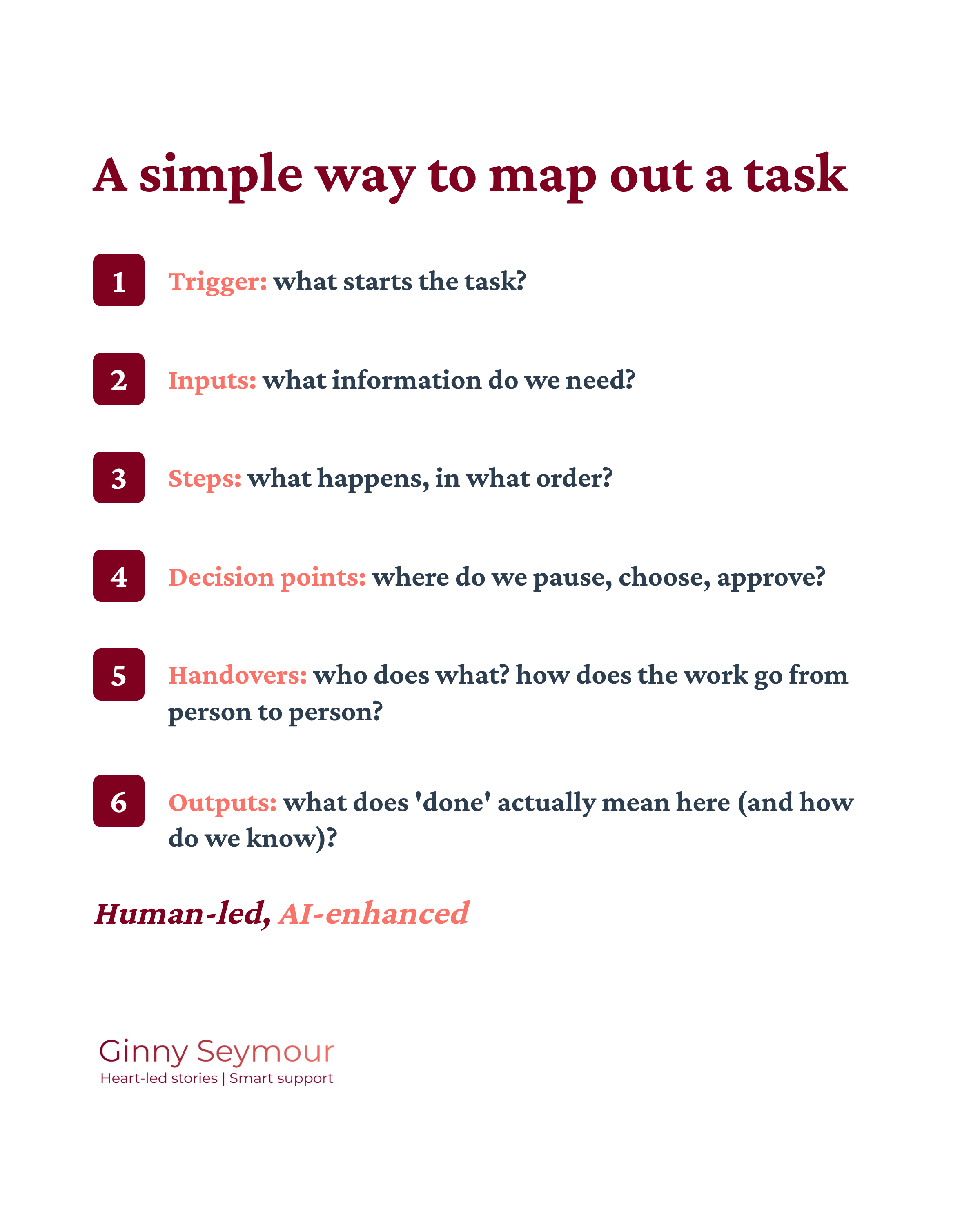
Trigger: what starts the task?
Inputs: what information do we need?
Steps: what happens, in what order?
Decision points: where do we pause, choose, approve?
Handovers: who does what? how does the work go from person to person?
Outputs: what does ‘done’ actually mean here (and how do we know)?
You can do this in a a notebook, on a Google doc, a whiteboard photo - anywhere. The format matters less than the content.
The questions that reveal where AI can genuinely help
As you map it out, ask:
Where are delays happening?
Where are we repeating ourselves?
Which parts drain time and energy?
Which parts need human judgement?
Which parts are pure admin?
Where’s the back-and-forth?
Where could AI step in without losing the human touch?
That last question matters most. The objective here isn’t to automate everything but to bring AI in where it can help to reduce the load and smooth the process without any negative impact on your brand, product and people.
A useful rule of thumb: focus on the admin, not the decisions
In most founder-led businesses, the most effective early uses of AI include:
researching
summarising
organising
drafting (with a strong brief)
spotting patterns in the detail
generating ideas and alternatives
reducing repetition
On the other hand, it pays to keep your people front and centre for:
brand decisions
customer nuance
relationship-building
creative direction
ethical judgement
When you have a division of work like the above, the result is a human-led, AI-enhanced approach - exactly the balance you need to thrive in this new era.

Don’t add to the chaos. Define the process first.
Documenting process can feel slow and painful. But it’s the bedrock of truly impactful AI use.
Don’t bring in AI to add to the chaos. Define the process, brief the tool properly, and you’ll give it the headstart it needs to genuinely lighten the load.
